Congressmen Don Beyer (VA) and Jamie Raskin (MD) and Senator Peter Welch (VT) have recently introduced a Ranked Choice Voting Act to bring ranked voting to congressional elections across the US. Such an election reform would make enormous strides in giving voters more choice, reducing political polarization, and creating a political system that better reflects the preferences of the electorate.
However, one small tweak to the legislation would transform this great bill into a fantastic bill. The Tabulation Process describes the instant runoff tabulation method, whereby in each round, the active candidate with the fewest votes is eliminated. This method can be problematic because it can lead to the elimination of a candidate with broad support in an early round. This is described in Section 331 (2) of the bill:
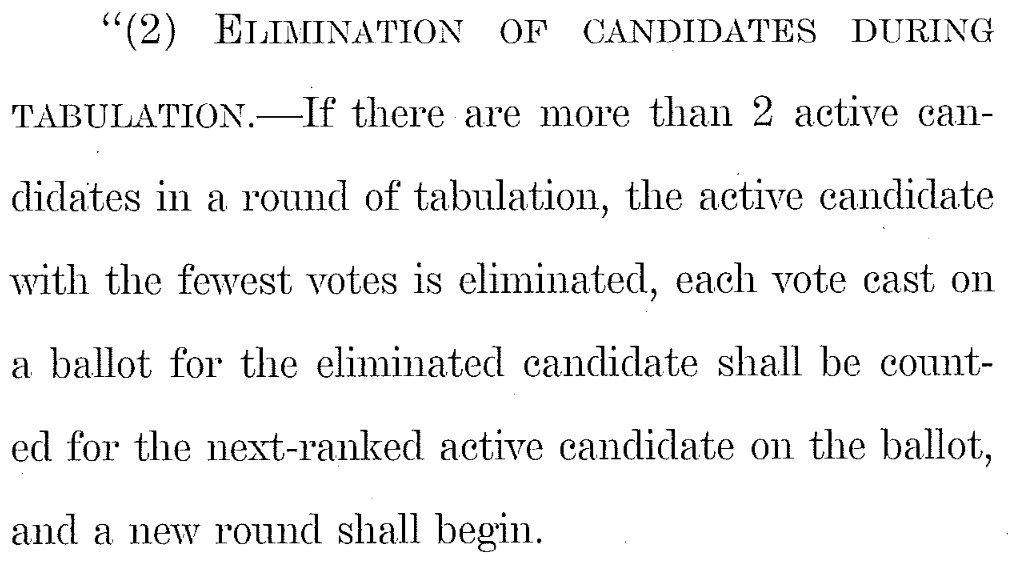
It’s not just a theoretical possibility that this instant runoff tabulation method can eliminate a consensus candidate too early: this is exactly what occurred in the 2022 Alaska special election for the House of Representatives. Fortunately, though, one small tweak to the tabulation method completely fixes this problem.
This Tabulation Process section would just need to be tweaked to say that in each round, the two active candidates with the fewest votes are compared head-to-head, and the loser between the two is eliminated. Everything else is the same, including the ballot design section of the bill. But this small tweak would yield a ranked voting system with way more desirable properties than what is described in the current version of the Beyer/Raskin/Welch proposed Ranked Choice Voting Act. Getting election reform right by paying attention to these issues is critical to mitigate backlash against electoral reforms that are enacted.